
Traps, Forced Moves, and Forks
Chess lessons in test prep

Traps
In chess, a trap always makes sense for the victim within a limited context. It turns a generally-rewarding behavior into a damaging one. If you allow me to take your queen with my rook, that’s a great trade for me in isolation. But if my rook was protecting my back rank from checkmate, and you are now free to swoop in with your rook to checkmate me, then I’ve fallen for a trap.
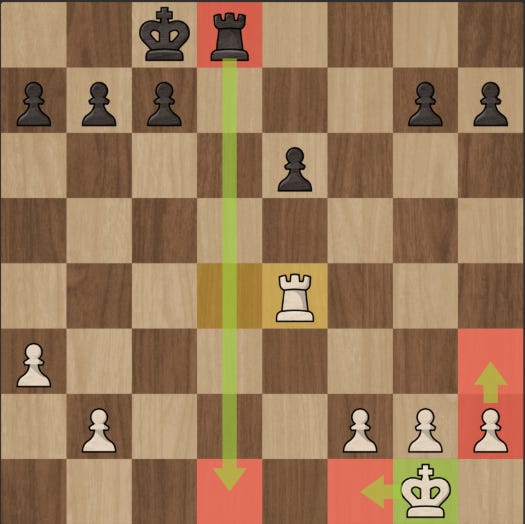
Notice that the trap only works if you know that a queen is worth more than a rook.
The same is true of traps in test prep – they victimize students who are doing something right. In reading comprehension, sometimes the first part of an answer is excellent – it’s some phrase at the end that disqualifies it. The student who picks that answer has actually done something good (recognizing that part of the answer was a good fit), but has failed to gather the full context. Another common trap is to spend too long on hard questions. Refusing to quit on hard problems is often admirable in real life, but it’s a tactical error on a standardized test: you won’t have enough time for other, easier questions.
These traps often rely on a certain combination of inertia and impatience. Here’s one more example:
“If the area of a rectangle is 63 and its width is 7, what is its perimeter?”
Students are so used to being asked for the other dimension that they answer 9 instead of finding that dimension and then using it to calculate the perimeter. As in the other examples, there’s a logic to this answer, but the student derives it mechanically: this is what I normally do. If you haven’t quite gotten the right context, your habits work against you.
Forced Moves
If you’re working on chess tactics, you might see a puzzle that says something like “Checkmate in three.” The idea is that there’s a series of three moves that will lead to victory, and there’s nothing your opponent can do about it. Every move is forced. For example, this might happen if your opponent can only move into check (illegal, or automatic loss) or move to exactly one open square. You keep moving them to “the only open square” until you’re able to checkmate them.
I love finding question sequences that lead a student from confusion to understanding with very few words from me. It’s a form of “checkmate in three,” except we both win.
But these “forced moves” are my own trap in tutoring – if I’m too eager to help a student master a single skill, I’ll lose track of the broader context and ultimately hinder my student.
Most complex questions require a combination of skills – a single math question could require a student to understand the coordinate plane, circle equations, the pythagorean theorem, and the idea that all radii in a circle are the same length, not to mention basic arithmetic and algebra. I can help the student master that exact question, but what if the numbers changed? What if the principles were combined differently, so that the problem looked quite different at first? How can I know – know for sure – this student will never miss a question like this again? There isn’t any way to devise a linear path we can follow check-check-check to complete mastery of those topics.
And if I chase that certainty, I’ll be neglecting other important issues. The student may also need help with other math topics, with reading, with time management, with “real test” pressure, with general confidence and motivation. I have to find the right balance, so that my student progresses as much as possible across all of these areas.
Forks and Skewers
Most chess tactics seem to be based on double-threats. Good players are aware of many opportunities throughout the game and seek to exploit two or more at the same time. For example, a knight might check the king while also threatening a rook (a fork, see image1). After the opponent moves his king, he loses his rook. Or a rook might check the king, which is directly in front of the queen (a skewer). When the king moves, the rook is free to capture the queen.
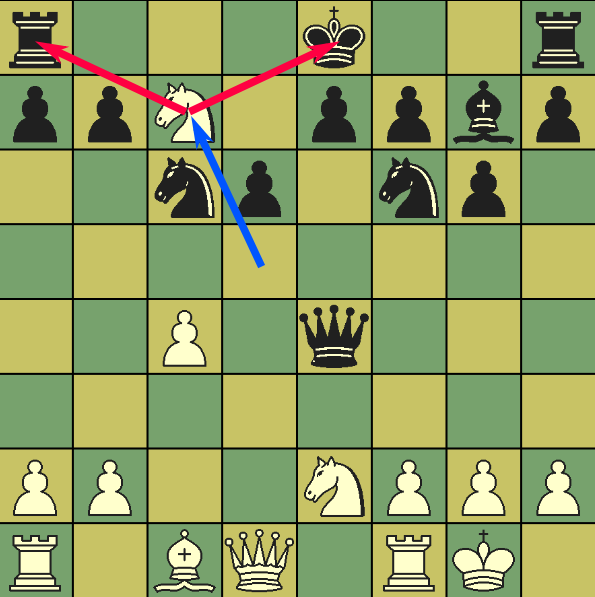
You can do a version of this in test prep, targeting multiple goals at the same time. But whereas in chess you can only take one piece per move, test prep allows you to enjoy all of the benefits of your multi-purposed activity. Here are a few examples that have worked for me:
Seek out questions that target multiple skills. Example: If the length of a rectangle is increased by 10% and its width is decreased by 20%, by what percent does the area decrease?
Work on “real test” pressure and high-value questions at the same time. Let’s say you’ve determined that 30 math or grammar questions are particularly important. You can turn those into a game – set a time per question, award scores based on results.
Mock tests. This is probably the best example: when proctored correctly, mock tests replicate the real-test experience, reinforce previous skills, and motivate students to practice more.
In chess, you aren’t executing a wild tactic every move, and the same is true in test prep. With every move, you methodically improve your position: occupying valuable territory, capturing your opponent’s pieces, and making your own pieces stronger – no longer stuck behind a bunch of pawns, but poised to strike at valuable material.
Thanks to https://chessreviewknight.home.blog/2018/08/07/famous-chess-game/ and http://my1400.life/content/back_rank_mate.php for these images!
This is so true. I see many students who can do all the basic skills, but have difficulty executing all of them together.
Really enjoyed this one, Mike!