

NBA great Bernard King once sat for an interview with Bill Simmons. How, Simmons wanted to know, did you become such a dominant offensive player, one of the very best of your era? King's answer: intelligent, targeted practice.
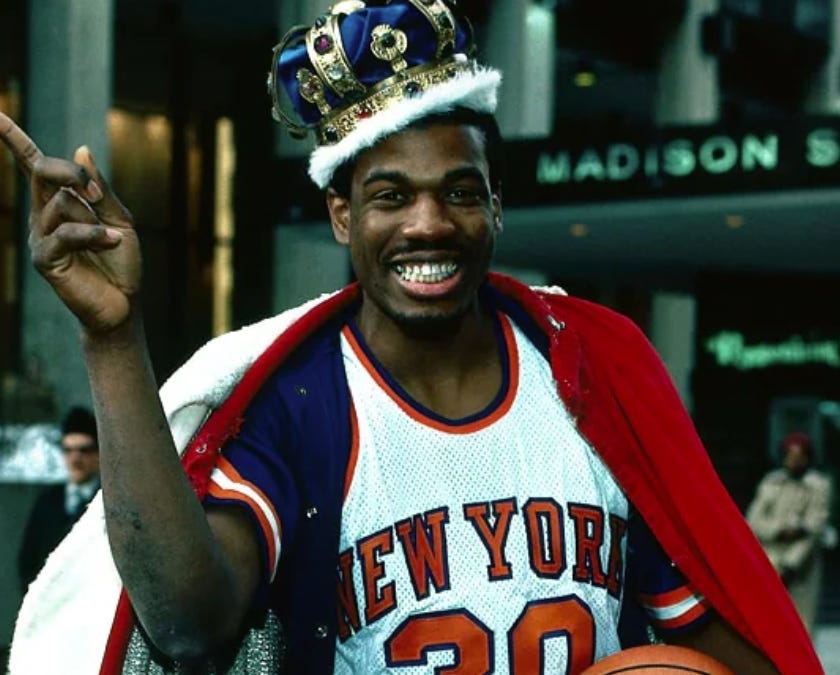
“I thought the game out because I didn’t think I was a very creative player, Bill. And so, on the wing position, at the small forward position, there’s only five ways you can be defended by a single defender. Only five: force you right because they think you have a weak right hand; force you left because your left hand is weak; give you the jump shot because they think you’re a poor jump-shooter; play you tight because you don’t have the ability to break down defense; or deny you. Those are the only five ways you can be defended by a single defender at the wing position. So to be an effective scorer, all you have to do is come up with five moves to counter the five defensive ways you will defend me – and you have to give me one…. So if I have five moves to counter your five ways you’re going to defend me, all it comes down to is this: on the left hand side of the floor I had nine spots I would shoot from….same thing on the right side of the floor…..and then in the center of the lane...you got (18,) 19, 20 in the middle (foul line is 20), between the top of the key and the foul line is 21 and then 22 at the top of the key. So I got 22 spots that I’m going to operate from--you’ll never see me shoot anywhere else. Then, obviously, transition. But, five ways to be defended, I got five counters to how you’re going to defend me and I’m going to get to one of those spots and it comes down to, how well am I shooting the ball that night? And that’s the way I practiced every day. So that’s why I shot for over 52% in my career.”
If he wasn’t a “creative player,” King was certainly a creative thinker: No matter where he got the ball on the court, and no matter how he was defended, King knew he would be able to get to one of 22 spots. And when he got there, he’d be ready, because he’d practiced those 22 shots over and over (highlights here). Interestingly, he said he only worked on those shots. He did not practice every shot from every spot on the floor, presumably because it would be too hard to master and maintain all of them. Instead, he focused on a small number of skills that would help him the most, based on his other skills and the situations he encountered again and again in real games.
I’ve always wanted Mathchops to help students be like Bernard King: analyze the test, figure out what situations are likely to come up, then practice the skills that are most likely to help you in those situations, taking into account the skills you already have.
Of course, there are more than 22 math skills1. And it’s not just about those math skills – you have to employ them in different contexts and combine them in various ways. At the risk of using too many sports analogies…It's like if you mapped out the 500 most important shots in tennis – not just forehands and backhands, but very specific situations, like hitting a forehand down the line while running to your right on the baseline, or hitting a backhand topspin lob from one corner of the court to the other. You would also include short sequences, like maybe hitting a deep forehand to one corner and then hitting a deep forehand to the other corner.
It’s too much for most people to track. What skills do you have? Which ones do you need? Which ones should you prioritize? But suppose you have an intelligent ball machine that monitors your execution of these shots and picks the best ones for you to work on in response. This system would allow you to master all of the most important skills in a very thorough and efficient way.
There are problems with this approach. For one thing, real games are always a bit different — they are more stressful, and they always present novel situations. The speed, spin, and location are never quite the same. If you want to be a good player, you can’t just practice with ball machines all the time — you have to play real games too.
But there are also problems with just playing games. You might have all kinds of weaknesses in your game that never get addressed. Suppose you can’t hit a backhand, or your second serve is weak. Suppose Bernard King never did develop his jump shot, or never did work on his left hand. Playing games isn’t enough to solve these problems, any more than taking lots of tests will help you understand circle equations. In the moment, faced with the pressure of a real game, you have to react. And if the skill isn’t there, you’ll react with the same mistakes time after time. To avoid those mistakes and improve your performance, you have to analyze the game, analyze your own abilities, find the skills that matter for you, and master them.
In fairness, Bernard King had more than 22 skills too. He didn’t mention all of the other skills – being able to drive in either direction and score with either hand; reading the defender quickly; developing strength, speed, and stamina.